Bento turns PowerPoint into one shareable HTML file. Edit, view, and collaborate without leaving the browser.
Bento is a web-based presentation tool that packages entire slideshows into single HTML files, integrating with Claude Code for AI-assisted editing and real-time collaboration without manual code intervention.
July 30, 2026
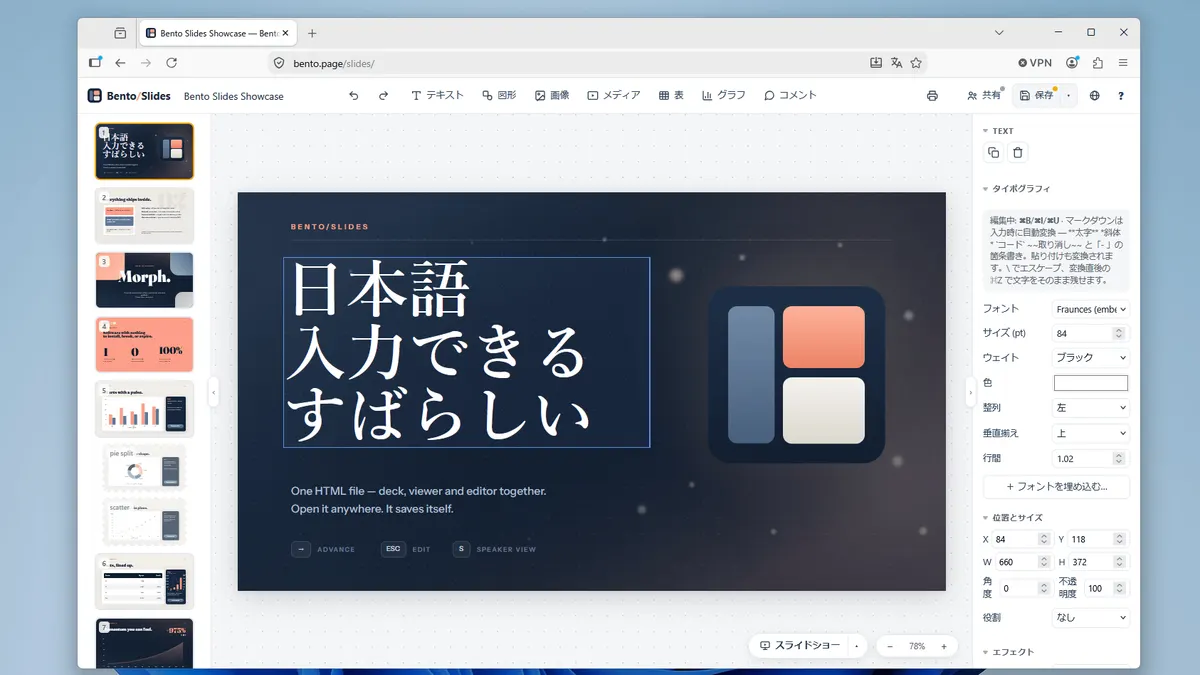
Are you the kind of developer who keeps a slide deck in a Git repository, argues with designers about whether Keynote exports are reproducible, and has at some point seriously considered writing a presentation in Markdown just to get version control for free?
Bento is a web-based presentation tool that ships an entire slide deck as a single HTML file. Edit it, view it, share it, collaborate on it. No PowerPoint license. No Google Slides account handoff. One file that contains everything. The Hacker News submission noted it integrates with Claude Code and other AI coding harnesses, which is where this gets interesting for a specific kind of user and completely irrelevant for everyone else.
Which users should pay attention and which should ignore this entirely
The decision here is not "is Bento good?" It is whether the single-HTML-file model solves a real problem you actually have. Work through this before spending time evaluating it.
If your presentations live in shared Google Slides and your team edits them asynchronously with comments, Bento does not obviously improve your workflow. The collaboration model is different, not strictly better. Skip it.
If you are a developer who builds presentation tooling, demos, or technical documentation that you then hand to an AI coding agent for iteration, Bento is worth a serious look. The reason is structural: a self-contained HTML file is something Claude Code can actually read, modify, and write back without any API integration, export step, or format conversion. Your slide deck becomes a text artifact that agents can treat like source code.
If you run a team where presentations are generated from data, the single-file model could eliminate an entire class of manual updates. The data lives in the file. The structure lives in the file. Update one, both change.
If you need enterprise permissions, admin controls, SSO, or compliance sign-off, stop here. Bento is a Show HN project. It is not an enterprise product yet, and evaluating it against Powerpoint's feature surface is the wrong frame.
A short decision sequence:
- Do you work in or adjacent to code? If no, default to the tool your team already uses.
- Do you use an AI coding agent as part of your workflow? If yes, the single-file format is directly useful. Read on.
- Do your presentations contain live or changing data? If yes, the self-contained model removes a synchronization step that currently requires manual work.
- Do you need real-time collaborative editing by non-technical teammates? If yes, evaluate whether the editing interface is accessible enough for them. If no, the format works fine for solo or small technical teams.
The skeptical case: a single HTML file is not a presentation platform
Here is the opposing argument, stated plainly. Bento is a clever hack, not a presentation workflow.
The problems PowerPoint and Google Slides solve are not primarily format problems. They are distribution problems, permission problems, and organizational memory problems. A single HTML file does not have a sharing model that a VP of Sales can understand. It does not have a permissions layer. It does not plug into a company's existing storage and access controls. When someone asks "can you send me the latest version of that deck?", the answer from a Bento workflow is "here is a file, I think this is the latest one." That answer is worse than "here is a link."
The AI integration angle is also easier to overstate than to verify. Yes, Claude Code can edit an HTML file. It can also edit any other plain text format. The advantage over a Markdown file or a JSON-based slide format is not obvious. If anything, HTML is more verbose and harder to diff cleanly than a structured format purpose-built for slides.
Single-file tools also tend to hit scaling walls fast. They work beautifully at 10 slides and 2 megabytes. At 80 slides, embedded fonts, and a dozen images, "one file" becomes "one very large file" and the benefits start reversing. Browser memory, load time, and the difficulty of reviewing a 40MB HTML blob in a pull request all become real problems.
None of this means Bento is bad. It means the use case is narrower than the headline implies, and a developer excited about the format should be honest about whether the limitations matter for their specific situation before committing.
Why the AI coding agent integration matters more than the file format
The headline says "one HTML file." The interesting part is buried in the Hacker News description: it integrates with AI coding harnesses. These two facts are connected in a way that is worth unpacking.
Most presentation tools have a hard separation between the presentation layer and the data layer. Slides live in one system. The data that populates them lives somewhere else. Charts get updated manually. Tables get copy-pasted. The workflow is: data changes, human opens the deck, human updates the relevant slides, human re-exports or re-shares. That loop has not fundamentally changed in decades.
When you give an AI coding agent a self-contained HTML file where all the state is in one place, you are removing that loop. The agent reads the file, understands the structure, modifies the relevant section with new data or a revised slide, and writes it back. No API integration. No export. No manual step. This is not a new idea in principle, but it has been practically blocked by file formats that were binary, proprietary, or stored in remote systems the agent could not access without additional tooling.
What stands out here is that the value of AI coding agents in non-code workflows scales directly with how much of the workflow is expressed in text. A Google Slides deck is not a text artifact in any meaningful sense. A Bento HTML file is. That is the actual unlock, and it is not about Bento specifically. It is about what happens when document formats become legible to agents. The same logic applies to any tool that exports structured, readable text as its primary format. Bento just happens to be doing this for presentations, a format that has been unusually resistant to this kind of machine legibility.
It also creates an interesting feedback loop with tools like locally-run models integrated with Claude Code. If the entire slide deck is a local file, a local agent can edit it without sending your data to any external service. For sensitive presentations, that matters.
A conversation worth having before you build on this
Developer: I want to use Bento for our quarterly business review deck. The data changes every week. Right now someone manually updates 12 slides from a spreadsheet. An agent could do that.
Skeptic: What happens when the HTML structure changes between versions? Your agent prompt that worked in April breaks in July and nobody notices until the deck is wrong in front of the board.
Developer: That is a real risk. But it is the same risk as any template-based automation. The alternative is a human making 12 manual updates every week, which also breaks, just more slowly and with less diagnostic information.
Skeptic: Fair. But who owns the file? Where does it live? How do you prevent two people from saving conflicting versions?
Developer: Git. Same as code.
Skeptic: Your finance team is not going to use Git.
Developer: My finance team does not edit the HTML. They edit the spreadsheet. The agent handles the rest. That is the whole point.
Skeptic: Then you have rebuilt a data pipeline with a presentation layer bolted on, and Bento is just the output format.
Developer: Yes. And the output format being a single readable HTML file is why it works.
The question this raises that nobody has answered yet
Bento works because its format is legible to agents. Google Slides and PowerPoint are moving toward AI features, but those features are integrated into the application, not exposed through the file format. The file format stays closed.
The open question is whether any of the major presentation platforms will ship an export or native format that gives agents the same kind of direct access Bento's HTML approach provides. If they do, the single-file tool advantage collapses. If they do not, because doing so would require exposing too much of their platform to competitors, then the gap between agent-friendly tools and incumbent tools will widen in ways that are hard to predict.
Watch how Claude Code integrations evolve in the next several months. The tools that make their core artifact readable and writable by agents will have a structural advantage in agentic workflows that has nothing to do with features and everything to do with format. Bento is the clearest current example of a presentation tool that made that choice. Whether that choice translates into adoption, or whether it stays a developer curiosity, is still very much unresolved. You can also compare how different AI coding agents handle non-code artifacts to get a sense of how much this format legibility question already shapes real workflows.
Tools mentioned in this article
Some links in this article are affiliate links. Learn more.