ai-codereal-world
Claude Code Malware Scan Regression Breaks Subagent Tasks
A regression in Claude Managed Agents causes malware scanning on file reads to trigger subagent refusals, disrupting code generation workflows for developers.
May 2, 2026
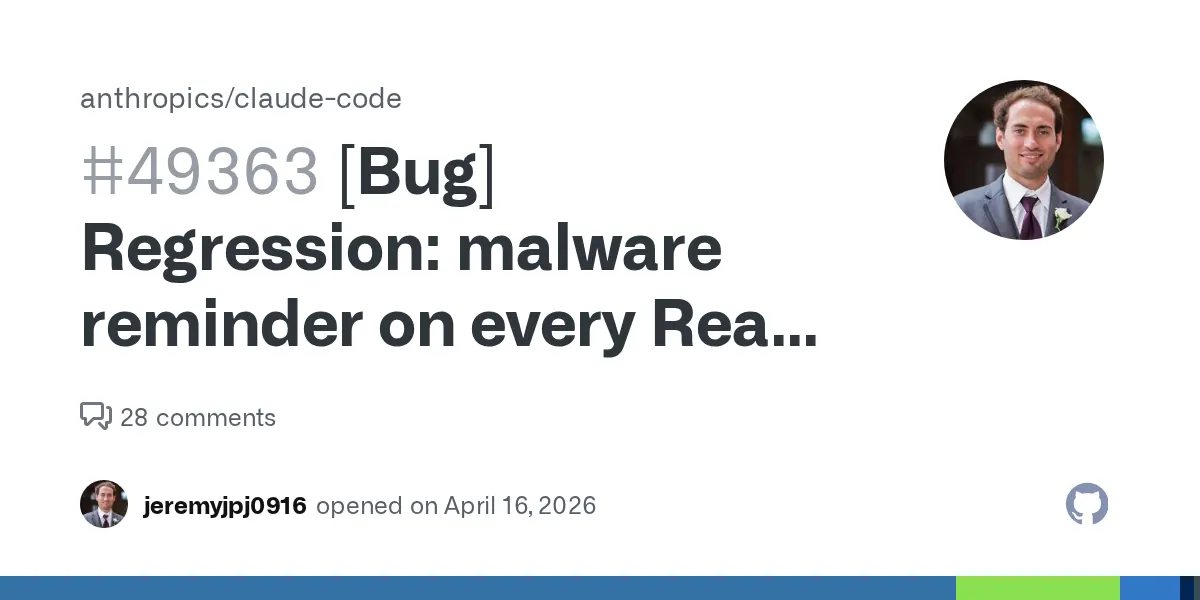
"Subagent refuses to read file due to malware reminder on every read."That line, filed as issue #49363 on the Claude Code GitHub repository, describes a regression that started blocking code generation workflows for teams using Claude Managed Agents. The bug is simple in structure: a malware-scanning reminder gets injected on every file read, and subagents interpret that reminder as a signal to refuse. The result is a multi-agent setup that can no longer do the thing it was built to do.
Claude Managed Agents versus the alternatives right now
If this bug is affecting your pipeline, the immediate question is whether to wait for a patch, route around it, or switch tools. Here is how the main options compare on the criteria that actually matter for agentic code workflows.| Tool | Multi-agent support | File read behavior | Refusal rate on benign code | Recovery path |
|---|---|---|---|---|
| Claude Code (current) | Yes, Managed Agents | Regression: malware reminder blocks reads | High when bug is triggered | Awaiting Anthropic patch |
| Cursor | Limited, single-agent by default | No malware-scan injection | Low on standard files | N/A - not the same architecture |
| Devin | Yes, full autonomous agent | Sandboxed reads, no injection issue | Low-moderate | Different pricing model applies |
The case that this bug is not worth your attention
Regressions happen. Anthropic has active engineers watching the GitHub issues queue and the Claude Code issue tracker has a track record of quick turnarounds on confirmed bugs. Issue #49363 was filed, acknowledged, and tagged within a short window. That is not a slow-moving organization. More pointedly: the class of user this affects is narrow. You need to be running Managed Agents specifically, reading files inside that agentic loop, and hitting the malware-reminder injection on those reads. Teams using Claude Code in simpler configurations, single-agent or direct API calls without subagents, will not see this. The issue title says "subagent refusals" for a reason. If your workflow does not use subagents, you are not in scope. There is also an argument that the underlying behavior, flagging file reads during automated workflows, reflects a safety mechanism that Anthropic deliberately built. The regression is that the reminder fires too often and the subagent over-weights it. That is a tuning problem, not an architectural flaw. It will be fixed by adjusting when the reminder fires or how subagents interpret it, not by removing the check entirely.How to work around the bug today
Until a patch ships, here is the shortest path to restoring function.- Confirm you are hitting the bug, not a different refusal. Run a minimal test: have your subagent attempt to read a single known-clean file. If the refusal message includes language about malware scanning or file safety reminders, you are on issue #49363. If the refusal is content-based, it is something else.
- Pin to an earlier Claude Code version if your environment allows it. Check your package lock or environment spec for the last version where reads were working. In most Node-based setups, that means checking
package-lock.jsonfor the@anthropic-ai/claude-codeversion and downgrading vianpm install @anthropic-ai/claude-code@<last-known-good>. - If pinning is not viable, restructure the agentic call so the primary agent handles file reads directly rather than delegating to a subagent. This sidesteps the subagent refusal path entirely while the regression is live.
- Add explicit context in your system prompt to clarify that file reads in this workflow are operating on project source files in a controlled environment. This does not fix the underlying issue but can reduce refusal frequency in some configurations.
- Watch the GitHub issue for the
fix: shippedlabel or a linked PR. Anthropic typically closes regressions like this with a point release rather than waiting for a major version.
What actually breaks in production
The failure mode here is not a crash. It is silent workflow degradation. A subagent that refuses a file read does not always surface that refusal visibly in the orchestration layer. Depending on how your pipeline handles agent responses, the refusal might be swallowed, logged as a completed step, or cause the orchestrator to proceed with incomplete context. Teams running code generation pipelines that depend on reading multiple source files in sequence are the ones most exposed. If a subagent is supposed to read ten files to understand a codebase and produces a refusal on files three and seven, the generated code will compile based on partial context. You will not necessarily get an error. You will get output that looks plausible but is missing awareness of whatever was in those two files. This happened to at least one user in the GitHub thread who reported that generated code was functionally wrong in ways that were hard to trace until they noticed the file-read refusals in verbose logging. That is the real cost: not the refusal itself, but the downstream output quality degradation that can pass QA if no one is watching the agent logs closely. For teams comparing Cursor versus Claude Code for agentic workflows, this is exactly the kind of incident worth factoring in. It is not about which tool is smarter. It is about which failure modes are visible and which ones are quiet.The number that defines the blast radius
1
malware reminder injection per file read triggers the subagent refusal path
TL;DR
A regression in Claude Code's Managed Agents causes subagents to refuse file reads after receiving a malware-scanning reminder on every operation, with failures that can be quiet rather than visible. Pin to a previous version or restructure reads through the primary agent until Anthropic ships a fix, and watch issue #49363 for the patch.
Tools mentioned in this article
Some links in this article are affiliate links. Learn more.