Midjourney Pivots From AI Images to a 60-Second Body Scanner
Midjourney, best known for its AI image generator, has spun up a medical division building a full-body ultrasound scanner it calls Ultrasonic CT. The pitch: MRI-quality scans in about a minute, no radiation, no magnets.
June 19, 2026
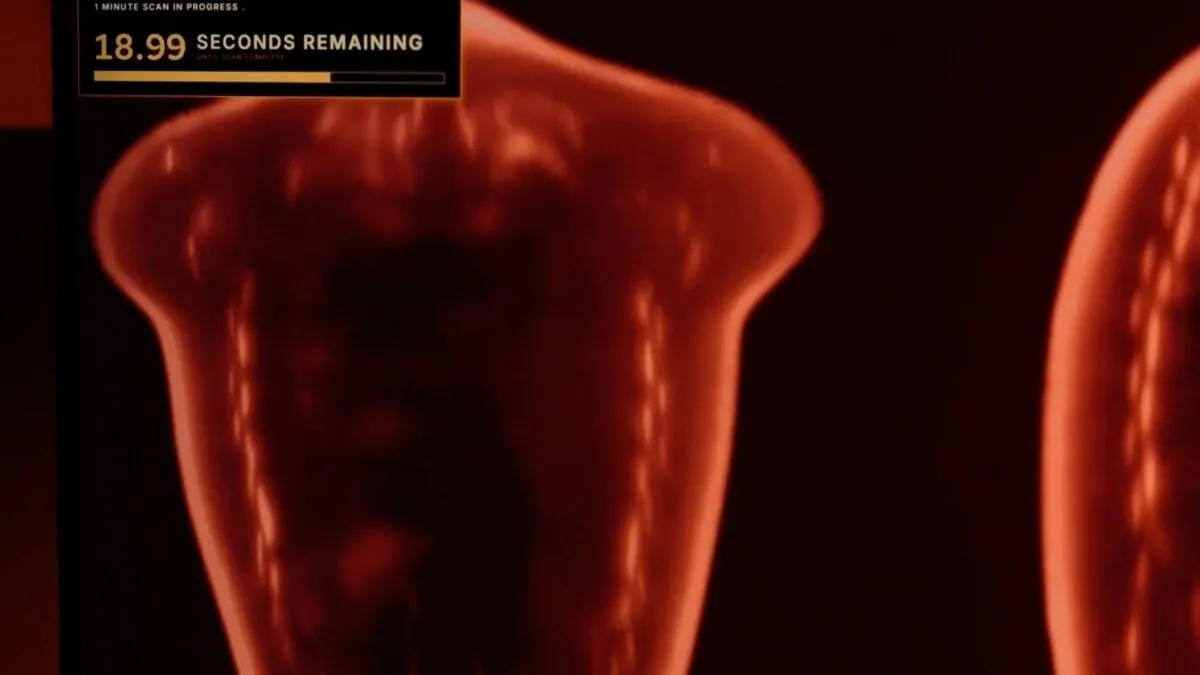
60 sec
Midjourney's eventual target for a full-body scan, versus the 30+ minutes a conventional full-body MRI takes - with no radiation and no strong magnetic fields
How Ultrasonic CT actually images the body
The patient stands on a platform that descends through a ring roughly 70 cm across, packed with hundreds of thousands of ultrasonic transmitters and receivers (Midjourney's own figures put the count near half a million). As founder David Holz described it, "hundreds of thousands of tiny elements take turns, sending out waves, listening together." The whole assembly sits in water, which couples the sound into tissue far better than air does. There is no ionizing radiation and no magnet, which is the entire point: the two things that make MRI and CT expensive, heavy, and slow are the two things this design throws out.
The catch is that ultrasound does not travel in straight lines through a body the way an X-ray does. Soundwaves bend, scatter, and reflect, so turning the raw signal into a clean image is a hard inverse problem. That reconstruction step, not the generation of pretty pictures, is where Midjourney thinks its engineering carries over.
The data and compute behind a single scan
The numbers are the most convincing part of the announcement. Independent analysis of Midjourney's specs describes roughly 40 GB of data captured per body slice, streaming in at about 17 GB/s, reconstructed by a cluster of 21 servers running near 2 PFLOPS. The current Gen 1 prototype resolves detail down to about 0.5 mm and takes roughly 20 minutes per scan. The 60-second figure is a target for a future generation that captures several hundred slices at once, with Gen 2 expected by the end of 2026.
That gap between the demo and the pitch matters. A 20-minute scan that needs a water tank and 21 servers is a research instrument. A 60-second scan you step into like a shower is a consumer product. Midjourney is announcing the second while shipping the first.
Why an image company thinks it can do this
Holz framed the move as leaning on what Midjourney already has: "skills across AI, imaging, sensors, visualization, and systems engineering." Notably, he was upfront that the scanner has "not even any AI immediately present" in the sense people expect from Midjourney's image generator. The value is in the hardware and the reconstruction math, not in a diffusion model hallucinating organs. That is a healthy distinction to draw early, given how easily "AI medical imaging" could be misread as "AI making up what is inside you."
It also means Midjourney's core image-generation product is no longer the whole company. For anyone choosing a creative tool today, that is worth noting: rivals like DALL-E, Ideogram, and Leonardo AI are pouring everything into image quality and features, while Midjourney is now splitting its attention between pixels and ultrasound.
The problems Midjourney has not solved yet
The skeptics are not wrong. The scanner currently produces coarser resolution than a modern CT or MRI, the water-immersion requirement is awkward for a walk-in wellness pitch, and the non-straight-line physics of ultrasound makes reconstruction genuinely harder than the marketing implies. There is also the regulator. The device is not cleared by the FDA for diagnostic use, so Midjourney plans to start by selling body composition maps, which do not require clearance, and to layer on diagnostic approvals incrementally. Butterfly Network, which already sells handheld ultrasound, issued public commentary on the announcement, a sign the incumbents are paying attention.
The ambitions are enormous: roughly 50,000 scanners deployed worldwide over six years, a stated goal of a billion full-body scans per month, and a flagship Midjourney Spa opening in San Francisco in late 2027 with expansion planned for 2028. None of that exists yet. What exists is a Gen 1 prototype, a year of planned research trials, and a founder willing to bet his image-generation profits on hardware. Whether this becomes the cheap MRI alternative it promises or a very expensive science project, it is the most interesting pivot an AI company has announced this year. The full announcement is at midjourney.com/medical, with reporting from Decrypt.
Tools mentioned in this article
Some links in this article are affiliate links. Learn more.