DeepSeek releases V4 Pro 0813. Reasoning and code get a boost.
DeepSeek's latest model update brings performance improvements focused on reasoning and code tasks. The new version is now available via OpenRouter.
August 14, 2026
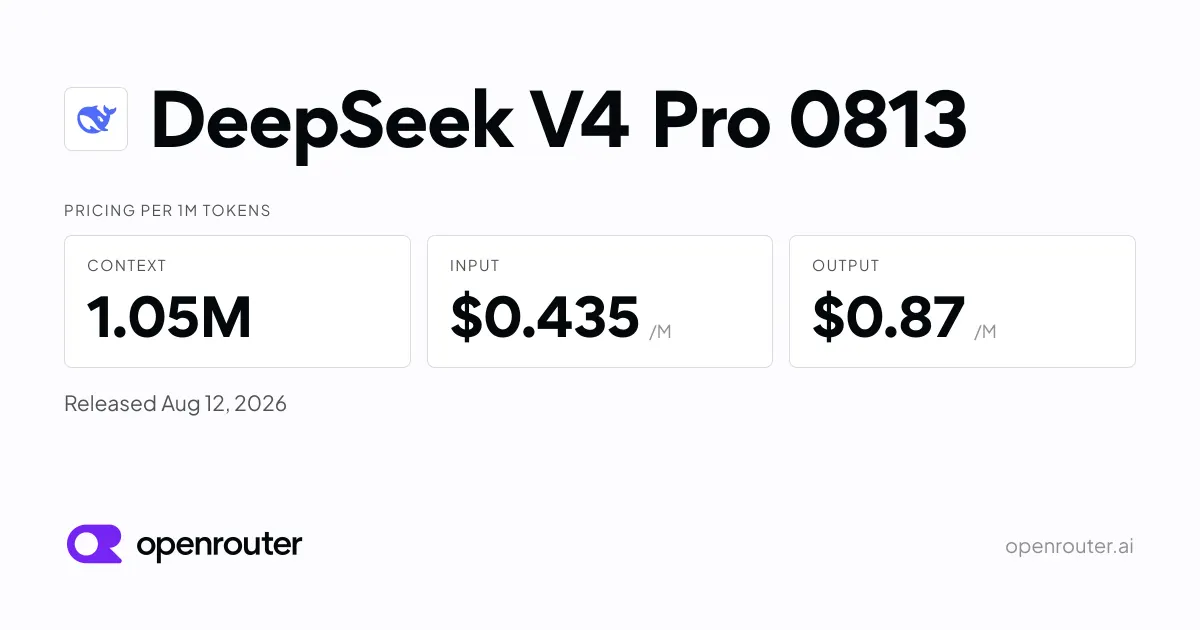
DeepSeek V4 Pro 0813 is not the model you switch to because of a benchmark. It is the model you switch to because the one you are currently paying for has started feeling expensive for what it delivers on reasoning and code tasks.
The 0813 update to DeepSeek V4 Pro landed quietly, announced through OpenRouter's model listing rather than a press conference. That kind of release cadence is worth paying attention to. DeepSeek has a pattern of shipping incremental updates that, taken together, close meaningful gaps with the frontier labs. The question this time is whether the reasoning and code improvements in 0813 are enough to displace Claude Sonnet 5 or GPT-5 from the workflows where they currently sit, and at what cost.
DeepSeek V4 Pro 0813 vs. the competition on the tasks that matter
The relevant comparison set for V4 Pro 0813 is not the cheapest models on the market. It is the mid-tier models that engineers and technical teams are currently running in production: Claude Sonnet 5, GPT-5, and Gemini 3.6 Flash. Those are the models V4 Pro 0813 is actually competing for budget against.
| Model | Input price (per 1M tokens) | Output price (per 1M tokens) | Reasoning focus | Code task focus | Release |
|---|---|---|---|---|---|
| DeepSeek V4 Pro 0813 | Not announced | Not announced | Yes (improved in 0813) | Yes (improved in 0813) | 2026-08 |
| DeepSeek V4 | Not announced | Not announced | Yes | Yes | 2026-04 |
| Claude Sonnet 5 | $3.00 | $15.00 | Strong | Strong | 2026-06 |
| GPT-5 | $1.25 | $10.00 | Strong | Strong | 2025-08 |
| Gemini 3.6 Flash | $1.50 | $7.50 | Moderate | Moderate | 2026-07 |
Pricing for V4 Pro 0813 has not been officially announced at the time of writing, which creates a real evaluation problem. You cannot model cost-at-scale until that number is confirmed. For teams on a fixed API budget, Claude Sonnet 5 at $3.00/$15.00 or GPT-5 at $1.25/$10.00 are known quantities. V4 Pro 0813 is not, yet.
For teams whose primary workload is code generation and multi-step reasoning: V4 Pro 0813 is worth testing seriously. For teams running summarization or extraction at volume: wait for the pricing page before changing anything.
How to decide whether to test V4 Pro 0813 now or wait
This is not a decision that needs a committee. It needs a decision tree.
If your team is running DeepSeek V4 already and your primary concern is reasoning quality on complex tasks, test 0813 immediately. The upgrade cost is essentially zero and the capability delta could matter for your hardest prompts.
If you are on Claude Sonnet 5 and happy with it, do not switch until DeepSeek confirms pricing. You are paying a known rate for known performance. Switching to an unpriced model in production is a budget risk, not a technical decision.
If you are using GPT-5 primarily for code tasks and have noticed it struggling on longer reasoning chains, V4 Pro 0813 is a reasonable parallel test. Run the same set of real production prompts against both, not synthetic benchmarks.
If your workload is mostly short-context tasks like classification, routing, or single-turn Q&A, skip V4 Pro entirely. The improvements in 0813 are specifically aimed at reasoning and code. You would not notice the difference, and Gemini 3.7 Flash at $0.75/$3.75 is almost certainly cheaper for that use case.
If you are evaluating for an agentic pipeline where the model needs to maintain state across many tool calls and reason about its own output, V4 Pro 0813 is exactly the model this update is targeting. That is where incremental reasoning improvements compound into real outcome differences over a long task horizon.
What the Hacker News thread actually said
"The 0813 naming convention is a date stamp, right? So this is just a checkpoint release of V4 Pro from August 13th. I'm curious whether this is a fine-tune or a full retrain. The performance jump on coding benchmarks would suggest something more substantial than a RLHF nudge." - Hacker News commenter on the V4 Pro 0813 thread
That observation cuts to the real uncertainty here. A date-stamped release like 0813 typically signals a checkpoint update rather than a ground-up retrain. The distinction matters because checkpoint releases can deliver meaningful improvements on specific task categories while regressing on others that were not in scope for this round of training. A model that gets better at code reasoning in August may have traded something subtle in creative instruction-following or long-context coherence to get there.
This is not a hypothetical concern. It happened with earlier model checkpoints from multiple labs, where a targeted improvement in one area introduced unexpected regressions in adjacent tasks. The safest approach is to treat 0813 as a candidate, not a replacement, until you have run it on your actual task distribution. The pattern of lab announcements overstating generalized gains is consistent enough that task-specific testing is the only reliable signal.
The cost of switching, beyond the token price
Token price is the number people quote. It is rarely the number that determines whether a switch is worth it.
Consider what a real migration from Claude Sonnet 5 or GPT-5 to V4 Pro 0813 actually involves for a team running it in production.
- Prompt compatibility: DeepSeek models respond differently to system prompt structure than Anthropic or OpenAI models. Prompts tuned for Claude's instruction style often need adjustment. Budget two to four engineering hours for a prompt audit on a moderate-sized deployment.
- Evaluation coverage: You need a test set that covers your actual failure modes, not just happy-path completions. If you do not already have one, building it takes longer than the migration itself.
- Pricing uncertainty: V4 Pro 0813 pricing is not confirmed. If you build a cost model assuming parity with V4 and the actual price comes in higher, your ROI calculation collapses.
- Team buy-in: If engineers have already built workflows and tooling around Claude or ChatGPT, switching the underlying model creates friction even when the API interface is compatible. That friction has a real cost in productivity during the transition period.
- Latency profiling: Reasoning-heavy models tend to be slower on time-to-first-token. If your application has a latency constraint, you need to profile V4 Pro 0813 under realistic load before committing.
None of these are reasons to avoid V4 Pro 0813. They are reasons to scope the evaluation properly before treating a promising release as a confirmed upgrade.
Why checkpoint updates compound over time
The underlying concept worth understanding here is why a date-stamped checkpoint release like 0813 can matter more than a version number suggests.
Think of a large language model as a function that maps input text to output text. The weights that define that function are set during training. A checkpoint is a snapshot of those weights at a particular point in the training run or fine-tuning process. When a lab releases a checkpoint update, they are shipping a version of the model where the weights have been adjusted, usually through additional fine-tuning on curated data, reinforcement learning from human feedback, or both.
The compounding effect comes from the fact that reasoning improvements tend to interact with each other. A model that is better at decomposing a multi-step problem is also, by extension, better at catching its own errors mid-sequence. That is not a separate capability. It falls out of the same improvement. So a targeted fine-tune aimed at code reasoning can produce measurable gains in adjacent tasks that require similar decomposition skills, like debugging, writing test cases, or explaining an algorithm.
This is why V4 Pro 0813 is worth watching even without confirmed benchmark numbers. If DeepSeek's reasoning improvements are architectural rather than surface-level, the gains will show up across a broader range of tasks than the announcement describes. If they are narrow fine-tunes, the gains will be real but limited to the specific task categories they targeted.
The way to find out is to compare it against your current tool on the tasks where you already know what good output looks like. That is the test that matters. Everything else is speculation until you have run it yourself. For teams already using DeepSeek in their stack, the barrier to that test is low enough that there is no good reason to wait.
TL;DR
DeepSeek V4 Pro 0813 is a checkpoint update with reported improvements to reasoning and code tasks, but pricing is unconfirmed and the gains are task-specific rather than universal. Test it against your own workload before switching from a priced, stable alternative.
Some links in this article are affiliate links. Learn more.