n8n
Open-source workflow automation you can self-host - with native AI agent support
Editorial take
n8n is the best automation platform for developers and technical teams who need full control over their workflows. The open-source core, self-hosting option, and code nodes make it the most extensible automation tool available. If you have hit the limits of what you can customize in Zapier, n8n is the natural upgrade.
What is n8n?
n8n is an open-source workflow automation tool that you can run on your own server or use via n8n Cloud. It works similarly to Make - you build workflows visually by connecting nodes - but includes native AI agent nodes that can reason, use tools, and loop until a task is complete.
The AI Agent node in n8n lets you define a goal, provide tools (HTTP calls, database queries, other workflows), and let it run autonomously. The agent decides which tools to use and in what order, rather than following a fixed sequence of steps. For building AI workflows that need real autonomy rather than just calling an LLM and passing the output forward, this is a different capability.
n8n has 400+ integrations covering most major tools (Google, Slack, databases, CRMs, webhooks, HTTP), with the node library growing as it is community-maintained. The self-hosted version is completely free. The cloud version starts at $20/month for 2,500 workflow executions.
The main trade-off is setup: self-hosting requires a server (a $5/month VPS works). For technical users comfortable with Docker or a basic VPS, self-hosted n8n offers strong value in automation - enterprise power at zero marginal cost. For non-technical users, n8n Cloud or Make is easier to get started.
Best for
Technical teams building automation with autonomous AI agents
Key strength
Self-hosted with autonomous AI agent nodes
Score breakdown (out of 5)
What you would use it for
- →Building complex multi-step workflows with conditional logic and custom code nodes
- →Self-hosting automation infrastructure to keep data entirely within your own systems
- →Integrating AI models (OpenAI, Anthropic) into business workflows without vendor lock-in
- →Automating data pipelines between internal databases and external APIs
- →Creating customer-facing automation with webhook triggers and custom processing logic
Pros & Cons
👍 Pros
- ✓Self-hosted option is completely free with no usage limits
- ✓AI Agent nodes are autonomous - not just fixed step sequences
- ✓Code nodes let you handle any logic that lacks a dedicated integration
- ✓Strong and growing community
- ✓Open source - no vendor lock-in
- ✓Sub-workflows function as reusable components across automations
👎 Cons
- ✗Self-hosting requires technical setup (Docker/VPS)
- ✗Cloud pricing is higher than Make for equivalent executions
- ✗Smaller integration library than Make (400 vs 1,800)
- ✗UI is less polished than Make or Zapier
Key Features
- ✓ Visual workflow builder with 400+ nodes
- ✓ Native AI Agent nodes - autonomous task execution
- ✓ Supports OpenAI, Claude, Gemini, Mistral as LLM backends
- ✓ Self-hostable - full control, zero ongoing cost
- ✓ Code node: run JavaScript or Python mid-workflow
- ✓ Sub-workflows: call other workflows as reusable functions
- ✓ Community templates library
Available on
Integrates with
n8n Pricing
✅ n8n has a free plan - no credit card required to start.
Self-hosted (Community)
- ✓Unlimited workflows
- ✓Unlimited executions
- ✓400+ integrations
- ✓AI Agent nodes
- ✓Requires own server (Docker/VPS)
Starter (Cloud)
- ✓2,500 workflow executions/month
- ✓5 active workflows
- ✓No server needed
- ✓Email support
Pro (Cloud)
- ✓10,000 workflow executions/month
- ✓15 active workflows
- ✓Version control
- ✓Priority support
Video Review
n8n vs Competitors
From the blog

One permission wasn't enough. The AI agent's token became a backdoor.
A developer granted an ops agent write access to pull requests, but the underlying token had push permissions too, creating an unintended security vulnerability that could compromise entire systems.
Sep 26, 2026
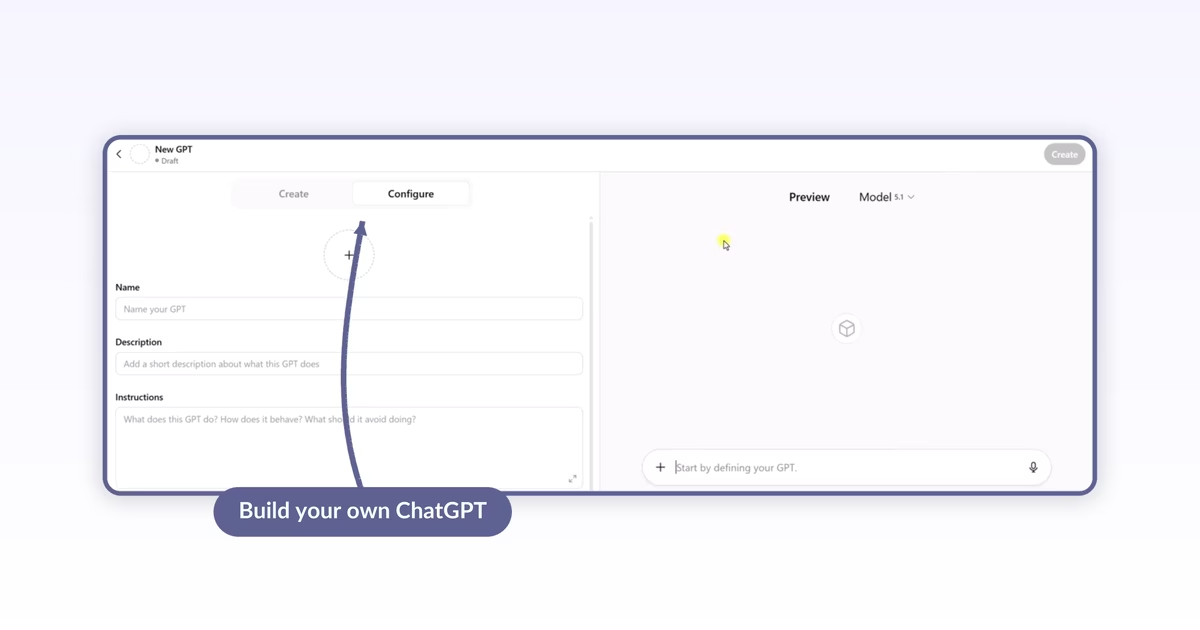
OpenAI is shutting down Custom GPTs. The feature dies in December.
OpenAI announced the phased deprecation of Custom GPTs starting this month, with complete shutdown by December. Users expressing concern are scrambling to find alternatives for their projects.
Sep 17, 2026
AI agents can now pay for things online. Here's what can go wrong.
A live protocol called x402 lets AI agents autonomously purchase web content using crypto payments with zero human approval. A developer explores the security risks and built tools to catch malicious spending patterns.
Sep 6, 2026
Developer resources
Related Tools
Make is the most visually capable automation platform available. Its canvas-based interface makes complex multi-step workflows easier to reason about than Zapier's linear format. The free tier is generous enough for light use, and paid plans offer strong value for teams automating high-volume processes.
OpenClaw is the most capable free autonomous coding agent available. With 60K+ GitHub stars and an MIT license, it handles multi-step development tasks - reading codebases, browsing documentation, running shell commands - without a $500/month subscription. Terminal-only interface requires technical comfort but capabilities rival paid alternatives.
Gumloop is the most accessible no-code automation platform for AI workflows. Its drag-and-drop node interface makes connecting AI models, web scrapers, and APIs practical for non-developers. For marketing and content teams who want to automate research, generation, and data enrichment without writing code, Gumloop is the right tool.
AI-powered advertising optimization and campaign management
This page contains affiliate links. We may earn a commission at no extra cost to you. Learn more.