OpenAI is shutting down Custom GPTs. The feature dies in December.
OpenAI announced the phased deprecation of Custom GPTs starting this month, with complete shutdown by December. Users expressing concern are scrambling to find alternatives for their projects.
September 17, 2026
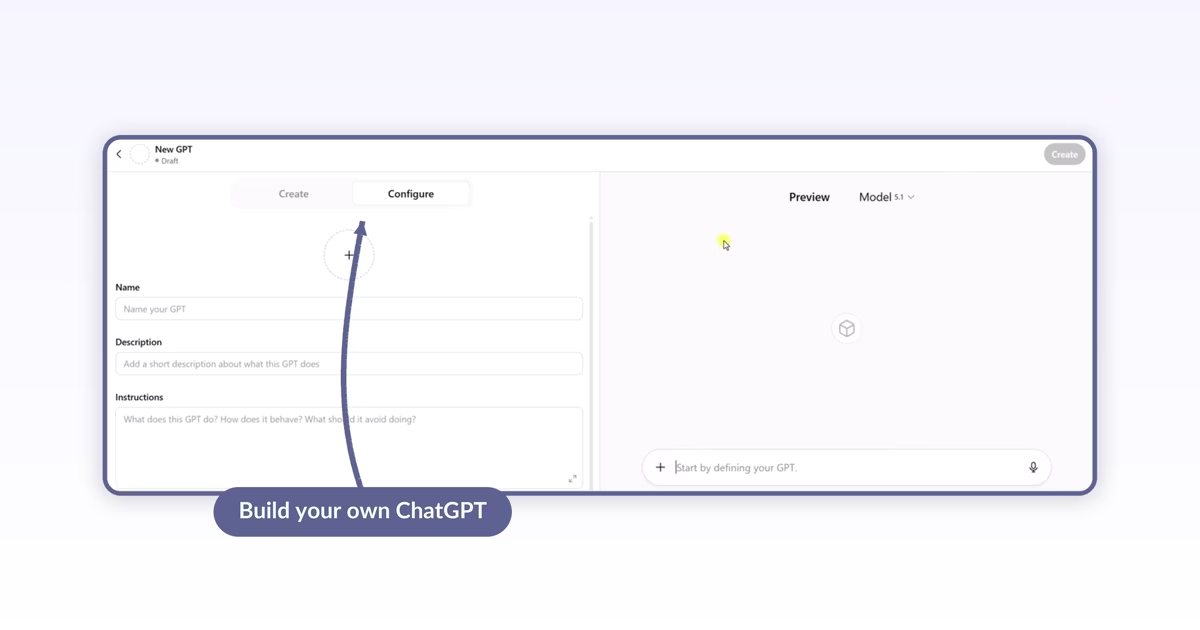
Ninety-some days. That is roughly the gap between OpenAI flipping the "we're phasing this out" switch on Custom GPTs this month and the date, some time in December, when the feature stops working entirely. According to a widely discussed thread on r/ChatGPT, users are already scrambling to figure out what happens to GPTs they built, published, or depend on for client work. OpenAI has not put out a detailed public roadmap alongside the announcement referenced in that thread, so treat the exact shutdown date as reported, not confirmed in writing by the company itself. What is not in dispute is the timeline pressure: a feature that has been part of ChatGPT since GPTs first shipped is now on a countdown clock measured in weeks, not quarters.
What to do with your Custom GPT before the clock runs out
Not every Custom GPT needs the same response. Sort yours into one of these buckets and act accordingly.
If your GPT is just a system prompt with some pasted instructions and no file uploads, no actions, no API calls: copy the instructions into a plain text file today. Rebuilding this anywhere else, including inside a fresh ChatGPT conversation with a saved prompt, takes ten minutes.
If your GPT uses a knowledge base (uploaded PDFs, docs, spreadsheets) but no external actions: export the source files now, before December, and plan to rebuild the equivalent inside ChatGPT Work or a Claude Project using Claude Connectors. The knowledge base logic is portable. The wrapper around it is not. If your GPT calls external APIs through custom actions (booking systems, CRM lookups, internal tools), you have real migration work ahead. This is the category most likely to break silently in December if you wait. Start testing an equivalent build in an automation platform like n8n or Make now, while the original is still live to compare outputs against. If your GPT is monetized through the GPT Store and generates any meaningful revenue, skip trying to preserve the exact same product. Build the replacement on infrastructure you control, because a platform feature you don't own is not a business asset, it's a rental.
The number that actually matters here is the deadline gap
~90 days
between phase-out start and full shutdown
Ninety days is a strange middle distance. It is too short to be a leisurely sunset and too long to force everyone to act immediately, which is exactly why threads like the one on r/ChatGPT are full of people who noticed the announcement but haven't touched their GPTs yet. If the window were twice as long, six months instead of three, most of that procrastination would still happen, just later, because deadline behavior doesn't scale linearly with deadline length. If it were half as long, 45 days, you'd see a much sharper spike in "how do I export my GPT" posts right now instead of a slow trickle. The actual number sits in the gap where people feel the deadline is real but not yet urgent, which is the worst place to sit if you have anything built on top of a feature slated for shutdown.
Broken links, API re-testing, and the trust tax you'll pay for migrating
The instructions-and-knowledge-base part of a Custom GPT is cheap to move. The part that costs money is everything downstream of "it worked before, why doesn't it work now."
If you shared a GPT link with clients, a support team, or students, every one of those people needs a new link, and some percentage of them will never click it. That's not a technical cost, it's an attention cost, and it's the one nobody puts in the migration checklist.
If your GPT had custom actions wired into a paid API, you're not just rebuilding logic, you're re-testing authentication, rate limits, and error handling in a new environment. Budget real hours here, not a rounding error. A team that built three or four internal GPTs for different departments should expect this to eat a full sprint, not an afternoon.
There's also a quieter cost: trust. Employees who got used to a stable internal tool and now have to relearn a slightly different one, even if the new version is objectively fine, lose a little bit of goodwill toward whatever platform choice comes next. That cost doesn't show up on an invoice, but it shows up in how fast people adopt the replacement.
A support GPT for a five-person consultancy
Say you run a small consultancy and built a Custom GPT last year that answers client FAQs, pulls pricing from an uploaded rate sheet, and drafts first responses to inbound leads. It's been running quietly in the background for months. Clients don't know it's a GPT, they just think support is fast.
Here's what December looks like if you do nothing: the link stops resolving, clients hit a dead end, and you find out because someone emails asking why the "help bot" disappeared. That's the failure mode worth avoiding.
Here's the alternative. In the next two weeks, pull the rate sheet and the FAQ document out of the GPT's knowledge base. Rebuild the same prompt logic as a saved workflow inside ChatGPT Work if your team already pays for it, or as a simple agent in Gumloop if you want it decoupled from any single chat platform. Test it against ten real client questions you've already answered, compare the outputs side by side with the old GPT's answers, and swap the link once you're confident. Total time: a few hours of setup, an hour of testing, and one email to clients with the new link. That's the whole migration, and it's small precisely because you did it before the deadline instead of after.
Three places to rebuild, and what each one actually gives you
| Option | Setup time for a mid-complexity GPT | Ongoing cost | Portability if the platform changes again |
|---|---|---|---|
| ChatGPT Work (built-in agent/workflow tools) | 1-3 hours | Included in existing plan for many teams | Low, still locked to one vendor's roadmap |
| Claude Projects with Claude Connectors | 2-4 hours | Included in Claude subscription tier | Low, same lock-in problem, different vendor |
| n8n or Make automation workflow | 4-8 hours | Usage-based, often cheaper at scale | High, workflow logic exports and moves with you |
If you want the fastest fix and don't mind repeating this exercise the next time a platform sunsets a feature, ChatGPT Work is the pragmatic choice. If your team already lives in Claude for other work, Claude Projects is the lower-friction option. If you've been burned by a platform deprecation once and don't want to be burned twice, put in the extra hours now and build it in an automation tool that doesn't depend on one chat interface.
The prediction worth checking back on in March
Here's a specific claim, checkable by March 2027, six months from today: most of the Custom GPTs currently sitting in the GPT Store will not get rebuilt anywhere. Not because migration is technically hard for the categories described above, it isn't, but because most of these GPTs were built once, used for a week or two, and quietly abandoned long before this deprecation was ever announced. The people posting in that r/ChatGPT thread right now, the ones actively worried about losing something, are the minority who built GPTs that still matter. If you're one of them, the work above is a few hours well spent. If you're not sure whether your GPT falls into that category, the fact that you haven't checked on it since building it is probably the answer.
Tools mentioned in this article
Some links in this article are affiliate links. Learn more.